
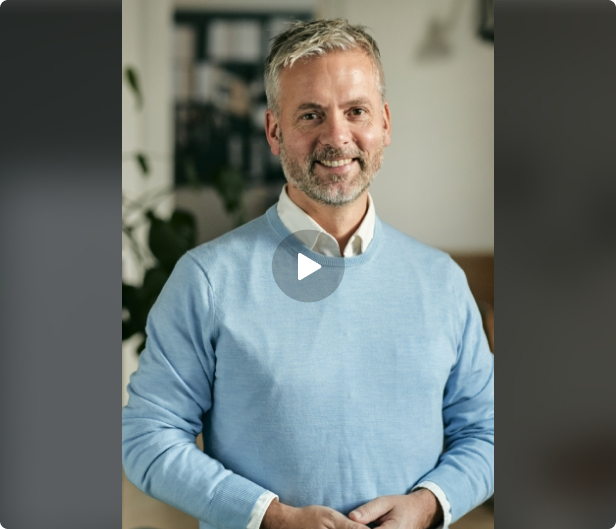
This short video shows how I help couples understand each other when their minds work in different ways, without treating difference as failure.
You can also send me an email
Neurodiverse couples therapy Copenhagen helps couples in which at least one partner is autistic, ADHD, AuDHD or otherwise wired differently. Together we untangle the misunderstandings, overload and hurt that build up, and agree on ways of living together that respect the capacity of each of you. Each meeting is two hours long and takes place in English or Danish, in person in my rooms in central Copenhagen or online.
It is a main branch of couples therapy. There are also pages for ADHD couples therapy, autism couples therapy, AuDHD couples therapy and neurodiverse couples therapy alone.
You can request a free discovery call, book a session, review my client policy or contact me directly.
This service suits Copenhagen couples who come together and where at least one of you is autistic, ADHD, AuDHD or similar.
If one of these describes you better, the linked page is probably a closer match.
You can also send me an email
The reviews shown here are shared by clients who have worked with me in therapy and chosen to reflect on their experience. They are collected via Google and displayed through an independent verification service, offering an open and transparent picture of how my work is experienced.
“With the neurodiverse couples I work with, what strikes me most is how lonely two people who love each other can feel. Underneath, one partner is usually wondering ‘Do you notice me at all?’, while the other asks ‘Why is who I am never enough?’. Some swing between ‘I need you close’ and ‘I can’t cope with you near me’ within an hour. When those questions are understood, the relationship can finally fit both of you.”
Mark Colclough, MA, psychotherapist and EFT couples therapist
I am Mark Colclough, MA, a psychotherapist and EFT couples therapist specialising in expats and international couples. I work in English and Danish, from my practice in central Copenhagen and online.
Practising since 2004, I bring a bicultural perspective to work with individuals and couples across languages and cultural contexts. My work integrates depth-oriented psychotherapy with approaches such as integral psychotherapy, Gestalt therapy, Jungian psychoanalysis, and object relations theory. I also have specialist training in attachment theory, narcissism, and borderline personality disorder.
For support with life between cultures, explore expat psychotherapy or expat couples therapy. My practice is supported by ongoing training and supervision. To read more about my background, training, and approach, visit About me.

I regularly meet with experienced senior psychotherapists in Denmark and abroad to reflect on my work, challenge my thinking, and continue developing my skills. This ongoing process supports the quality of my individual and couples therapy, helping me offer thoughtful, ethical, and effective care.
My focus is simple: excellence, integrity, and impact.
If you want me to call you ASAP, or if you want to book me, use the buttons below.
You are welcome to get in touch. We can clarify what’s the right therapy for you.
You can also send me an email
Simon is autistic and works as a software developer; his partner Louise has ADHD and is a nurse on shifts. Their evenings go wrong in the same way: Louise comes home full of energy and stories, Simon needs silence after a day of noise. She feels rejected; he feels invaded. Both are exhausted.
In our sessions, they see the cycle clearly for the first time. They agree a quiet half-hour when they get home, followed by a short, planned time to talk. Louise stops hearing silence as rejection, and Simon finds he can listen once he has rested.
I have presented this clinical example as a compound of 22 years of clinical practice.
Different minds are not the problem. Not understanding them usually is.
In a neurodiverse relationship, the same conversation can mean very different things to each of you. Over time, misunderstandings pile up and both of you feel unseen.
In therapy, we slow those moments down and find out what each of you is actually experiencing.
Noise, demands, plans that change and too many conversations can drain a neurodivergent partner long before the evening starts.
We look at where the load comes from, and how to reduce it.
One of you may be very direct, the other may hint. Both can feel unheard.
We find a way of speaking that works for both of you.
Uncertainty can make one partner ask for reassurance again and again, while the other feels criticised by every question.
We look at what the reassurance protects, and find other ways to give it.
When things become too much, one of you may go silent or leave the room. The other may feel abandoned.
We learn what a shutdown is, and how to handle it without blame.
Masking all day, or constantly making allowances, can leave either partner exhausted and resentful.
We name that effort so it can be shared more fairly.
Some couples begin to wonder whether two such different minds can live together.
We look at that question honestly, with what you have learned about each other.
Recognise yourselves? Book a time, ask for a call or simply send a few lines by email.
You can also send me an email
Your journey is unique, and you do not have to walk it alone.
Fill out your contact information and I will call as soon as possible.
Support when you need it most.
Your message is treated confidentially and used only to respond to your enquiry. It is not sold or used for advertising. Please avoid including detailed or highly sensitive clinical information in this form. Information about processing, service providers and retention is available in the privacy policy.
Understanding first. Then agreements that fit both of you.
We work on the cycle between you, the load each of you carries and practical agreements about communication, routines and closeness.
I help you trace a typical clash step by step: what each of you notices, feels and does. That shows where the cycle can be interrupted.
Yes. We learn the early signs of overload for each of you and agree what to do when you see them.
Yes. We practise saying needs clearly and checking meaning, so neither of you has to guess.
Yes. Adjustments should help both of you, not leave one partner doing all the adapting. We look for that balance.
Yes. We look at old hurts with what you now understand, so you can make sense of them and let some of them go.
Usually: fewer painful misunderstandings, less exhaustion and more ease with each other.
You can also send me an email
Labels are optional. Willingness to be curious about each other is what matters.
Early on I learn how each of you takes in information, what has been going wrong and what you hope for. Should something other than couples work fit better, I say so plainly.
The meeting is two hours, and pausing is always allowed. You each describe the situations that hurt most, and by the end we have a first sketch of the loop you get caught in.
Tell me what helps. Dimmer lighting, a different chair, more pauses, slower talk, notes on paper or an email beforehand are all fine.
Sometimes. A short individual meeting can help one of you say things that are hard to say together. I explain how that works first.
Most couples meet every second or third week. The gap gives you time to test new agreements at home.
Neurodiverse couples usually need a series of meetings, and booking them as a bundle reduces the price of each one. See the bundle cards lower down.
Fights are shorter, you recover faster and both of you feel more understood at home. At that point we review whether to carry on.

Not sure which page fits? Compare the closest services.
| Option | Choose it when | Pace |
|---|---|---|
| Neurodiverse couples therapy (this page) | A mix of profiles, or none in particular. | 2 hours, every second or third week |
| ADHD couples therapy | ADHD is the main theme. | Two-hour sessions |
| Autism couples therapy | Autism is the main theme. | Two-hour sessions |
| Neurodiverse couples therapy alone | Your partner will not come. | Hour-long individual sessions |
Therapy for two partners whose brains work differently, through autism, ADHD, AuDHD or something similar. I offer it in English or Danish in central Copenhagen.
Any couple where autism, ADHD or a related profile shapes daily life, whether that applies to one of you or both.
No. Plenty of couples arrive with only a hunch, or none at all. We work with what you notice in everyday life.
Yes. We work out what happens before a shutdown, what helps during it and how to reconnect afterwards.
Yes. We look at what the need for reassurance is about and how both of you can meet it in a way that lasts.
Yes. If one profile is central, see ADHD couples therapy, autism couples therapy or AuDHD couples therapy.
No. Assessment and medication sit with doctors and specialist clinics. My job is the relationship between you.
There is no fixed number. We check in regularly on whether the work is still useful.
Each two-hour couples session is 3,700 DKK, VAT included. The prices page lists everything, and bundles bring the cost down by 10 per cent. Online sessions cost the same and last just as long.
Use the online calendar, or start with a free 30-minute call if you would like to talk first. Email works too.
You can also send me an email
My mission is to help individuals, couples and families rediscover connection, communicate with understanding, and build a stronger, more loving relationship that can thrive through any challenge.
My vision is to create a world where every person in my therapy room feels supported, connected, and empowered to grow, and to step one step closer to your Self.

Join the newsletter and receive five practical tips for nurturing healthy relationships – with yourself and the people around you.
No spam. Just mindful insights.
I have designed this website to offer you a private, ad-free experience. Your personal data is never used, sold or shared with third parties. A few cookies are necessary for the site to work. If you say yes to helping me, I would also like to use one or two that show how the site is used, so I can improve its flow and content for you. It is completely pseudonymous, which means it does not identify you by name.
Please fill out this information and I’ll contact you soon. I use your details to reply to your enquiry, talk through practicalities and, if you wish, book a session. Please do not write sensitive information in the message field.
Clicking the button adds your email address to my mailing list. Please read the Privacy Policy for more information.
P.S. I’ll call you in a bit!
