
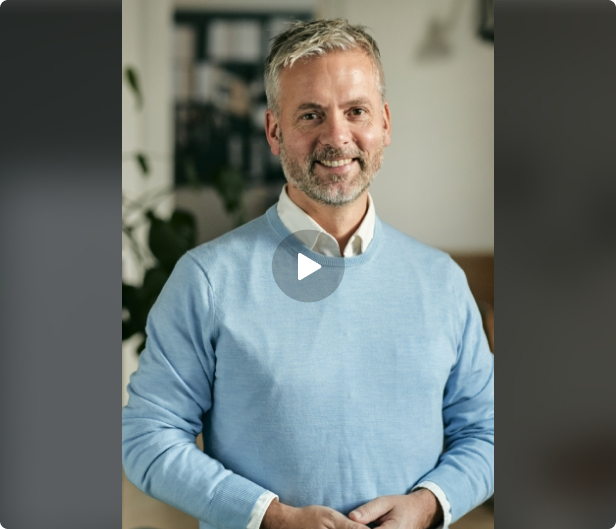
This short video shows how I help couples where ADHD affects attention, energy and the way chores and plans are shared.
You can also send me an email
ADHD couples therapy Copenhagen is for couples where one or both partners has ADHD, diagnosed or suspected. We work on the patterns ADHD can set off in a relationship, such as one partner managing and the other feeling criticised, and on practical agreements that suit an ADHD brain. Sessions are two hours, in English or Danish, in person at my practice in central Copenhagen or online.
It is a branch of neurodiverse couples therapy. If your partner will not come, see ADHD couples therapy alone. If autism is part of it too, see AuDHD couples therapy.
You can request a free discovery call, book a session, review my client policy or contact me directly.
This service suits Copenhagen couples who come together and where ADHD, in one or both of you, shapes daily life.
Another page may suit you better if one of the lines below sounds like you.
You can also send me an email
The reviews shown here are shared by clients who have worked with me in therapy and chosen to reflect on their experience. They are collected via Google and displayed through an independent verification service, offering an open and transparent picture of how my work is experienced.
“In more than two decades of sitting with couples, I have seen ADHD turn loving partners into manager and employee. Underneath, the organising partner is often asking ‘Can I ever rely on you?’, while the partner with ADHD asks ‘Will I ever be good enough for you?’. Some feel ‘Help me’ and ‘Stop telling me what to do’ in the same breath. When those questions come out, the partnership can begin again.”
Mark Colclough, MA, psychotherapist and EFT couples therapist
I am Mark Colclough, MA, a psychotherapist and EFT couples therapist specialising in expats and international couples. I work in English and Danish, from my practice in central Copenhagen and online.
Practising since 2004, I bring a bicultural perspective to work with individuals and couples across languages and cultural contexts. My work integrates depth-oriented psychotherapy with approaches such as integral psychotherapy, Gestalt therapy, Jungian psychoanalysis, and object relations theory. I also have specialist training in attachment theory, narcissism, and borderline personality disorder.
For support with life between cultures, explore expat psychotherapy or expat couples therapy. My practice is supported by ongoing training and supervision. To read more about my background, training, and approach, visit About me.

I regularly meet with experienced senior psychotherapists in Denmark and abroad to reflect on my work, challenge my thinking, and continue developing my skills. This ongoing process supports the quality of my individual and couples therapy, helping me offer thoughtful, ethical, and effective care.
My focus is simple: excellence, integrity, and impact.
If you want me to call you ASAP, or if you want to book me, use the buttons below.
You are welcome to get in touch. We can clarify what’s the right therapy for you.
You can also send me an email
Anna and Mikkel have been together eight years and have two children. Mikkel has ADHD. Anna runs the calendar, the shopping and the school messages, and reminds Mikkel several times a day. Mikkel feels like a child in his own home and has started to tune her out. Anna feels alone and angry.
In our sessions, they see the loop: Anna reminds, Mikkel withdraws, Anna reminds louder. They set up a shared board in the kitchen and a ten-minute check-in on Sunday evening, with Mikkel owning three tasks fully. Anna stops reminding; Mikkel starts noticing. Slowly they begin to laugh together again.
I have presented this clinical example as a compound of 22 years of clinical practice.
ADHD is not a lack of love. But without understanding, it can feel exactly like one.
ADHD can affect attention, memory, time and mood. In a relationship, that often turns into one partner reminding and organising, and the other feeling nagged and ashamed.
In therapy, we look at that pattern together, without blame.
When one partner keeps track of everything, they can end up feeling like a parent or a manager rather than a partner.
We look for a split of tasks that is fair and realistic.
A forgotten birthday or a missed pick-up can feel like a sign that you do not matter.
We separate what ADHD does from what it means about love.
Strong emotions can rise quickly with ADHD, and arguments can flare and fade within minutes, leaving the other partner shaken.
We work on catching those moments earlier.
Many people with ADHD have heard criticism all their lives. At home, every reminder can sound like more of it.
We make room for that experience too.
When life is all logistics, closeness and fun can disappear.
We look at how to bring them back in small, realistic ways.
After years of the same fights, both of you may doubt that anything can change.
We start with small changes that show it can.
If your home runs on reminders and resentment, get in touch. A short email is enough to start.
You can also send me an email
Your journey is unique, and you do not have to walk it alone.
Fill out your contact information and I will call as soon as possible.
Support when you need it most.
Your message is treated confidentially and used only to respond to your enquiry. It is not sold or used for advertising. Please avoid including detailed or highly sensitive clinical information in this form. Information about processing, service providers and retention is available in the privacy policy.
Less managing, less shame and more partnership.
We look at the cycle between you, how ADHD feeds it, and practical systems that do not depend on one of you remembering everything.
We take a recent fight and slow it down: the forgotten task, the reminder, the reaction, the silence. Seeing the loop helps you both step out of it.
Often, yes. We set up shared systems, such as lists, calendars or fixed check-ins, so tasks are visible and nobody has to chase.
Yes. When the non-ADHD partner understands what is happening, and the ADHD partner takes ownership, forgetting hurts less.
Yes. We agree signals for a pause and a way to return to the conversation once both of you are calm.
Yes. We plan time together that is easy to keep, so the relationship is not only about tasks.
For most couples, it means fewer reminders, fewer flare-ups and feeling like a team again.
You can also send me an email
Come with a diagnosis, a suspicion or just a lot of forgotten bin days. All are fine.
At the start, I want to know where ADHD gets in the way, how each of you describes the problem and what would count as better. I will be honest if I think something else would help more.
Over two hours, with a break if you like, you each walk me through a recent bad day. By the end we can draw the loop you keep getting stuck in.
I keep sessions structured, with a short summary at the end and breaks when needed. Fidgeting, moving around or taking notes is welcome.
No. I do not prescribe medication or work as an ADHD coach. Couples often find therapy works well alongside those, if you already have them.
A gap of two or three weeks between meetings usually works well. It gives a new system time to prove itself.
If you plan to come for a while, a bundle takes 10 per cent off each session and gives the work a clear shape. The options are shown in the bundle section.
Tasks get done with less friction, arguments cool faster and you have more fun together. When you get there, we talk about next steps.

Comparing options? Here are the closest pages.
| Option | Choose it when | Pace |
|---|---|---|
| ADHD couples therapy (this page) | ADHD in one or both of you; both attend. | 2 hours, every two to three weeks |
| ADHD couples therapy alone | Your partner will not come. | 1-hour individual sessions |
| AuDHD couples therapy | Autism is part of it too. | 2-hour sessions |
| Neurodiverse couples therapy | Several profiles, or none in particular. | 2-hour sessions |
Couples therapy for relationships where ADHD, in one or both partners, affects daily life together. I offer it in English or Danish in central Copenhagen.
A little. The patterns differ depending on who has ADHD, and I work with whichever pattern you have.
That is common. We look at how two ADHD brains manage a household, plans and emotions, and build systems that work for both.
No. Many couples come with a suspicion rather than a diagnosis. What matters is what you notice in daily life.
No. Both partners are part of the pattern, and both have things to change. The aim is a fairer relationship, not a project to fix one person.
Then AuDHD couples therapy or neurodiverse couples therapy may fit better. We can talk about it in a first call.
No. For assessment or medication, please talk to your GP or an ADHD clinic. I focus on how the two of you live together.
It differs from couple to couple. Every few sessions we stop and ask whether it is still helping.
A two-hour session for the two of you costs 3,700 DKK including VAT. See the prices page for the full list; a therapy bundle saves 10 per cent. Online sessions cost the same and last just as long.
Book directly, ask for a free 30-minute call first, or write to me.
You can also send me an email
My mission is to help individuals, couples and families rediscover connection, communicate with understanding, and build a stronger, more loving relationship that can thrive through any challenge.
My vision is to create a world where every person in my therapy room feels supported, connected, and empowered to grow, and to step one step closer to your Self.

Join the newsletter and receive five practical tips for nurturing healthy relationships – with yourself and the people around you.
No spam. Just mindful insights.
I have designed this website to offer you a private, ad-free experience. Your personal data is never used, sold or shared with third parties. A few cookies are necessary for the site to work. If you say yes to helping me, I would also like to use one or two that show how the site is used, so I can improve its flow and content for you. It is completely pseudonymous, which means it does not identify you by name.
Please fill out this information and I’ll contact you soon. I use your details to reply to your enquiry, talk through practicalities and, if you wish, book a session. Please do not write sensitive information in the message field.
Clicking the button adds your email address to my mailing list. Please read the Privacy Policy for more information.
P.S. I’ll call you in a bit!
