
Masterclass in intimacy
Three sessions on the closeness that went quiet
Built around the 2 of you, and it begins with a call before we meet
Why closeness goes quiet in a good relationship
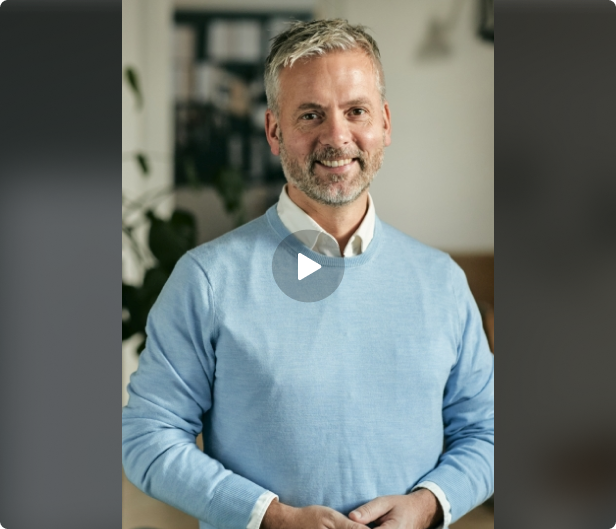
In this short video, I explain how 2 people who still care about each other end up living politely side by side, and what I work on across 3 focused sessions.
You can also send me an email
At a glance
Masterclass in intimacy. This is designed for 2 people who function well together and no longer feel close.
- Three 2 hour sessions with me, custom-built around your own relationship rather than delivered from a script.
- A free 30 minute onboarding call on Zoom with both of you, where we align expectations and goals before the first session.
- A complimentary 30 minute Zoom follow-up approximately one month after completion, to see what has stayed with you and whether any adjustments are needed.
- 10.300 DKK including VAT.
Across 3 sessions, we identify how distance developed, what happens when one of you reaches for closeness, and what each of you needs in order to feel safe enough to reach again. Emotional closeness, affectionate touch and sex are treated separately because they are not the same thing and do not recover at the same speed. The work is shaped around your pattern and your specific needs rather than a generalised idea of intimacy.
You can book the masterclass now, or read the other 2 masterclasses first: the masterclass in communication and the masterclass in recurring conflict. Terms and conditions are explained further down this page. If you are not sure which of the 3 fits you, request a call and I will tell you honestly.
Client reviews
The reviews shown here are shared by clients who have worked with me in therapy and chosen to reflect on their experience. They are collected via Google and displayed through an independent verification service, offering an open and transparent picture of how my work is experienced.
Meet Mark, psychotherapist and EFT couples therapist
I am Mark Colclough, MA, a psychotherapist and EFT couples therapist specialising in expats and international couples. I work in English and Danish, from my practice in central Copenhagen and online.
Practising since 2004, I bring a bicultural perspective to work with individuals and couples across languages and cultural contexts. My work integrates depth-oriented psychotherapy with approaches such as integral psychotherapy, Gestalt therapy, Jungian psychoanalysis, and object relations theory. I also have specialist training in attachment theory, narcissism, and borderline personality disorder.
For support with life between cultures, explore expat psychotherapy or expat couples therapy. My practice is supported by ongoing training and supervision. To read more about my background, training, and approach, visit About me.

The importance of supervision
Good therapy begins with good supervision
I regularly meet with experienced senior psychotherapists in Denmark and abroad to reflect on my work, challenge my thinking, and continue developing my skills. This ongoing process supports the quality of my individual and couples therapy, helping me offer thoughtful, ethical, and effective care.
My focus is simple: excellence, integrity, and impact.
Masterclass in intimacy: when is it the right fit?
Nothing is wrong, and you are further apart than you have ever been.
You do not need a crisis to come and see me. Distance is reason enough, and it is harder to raise than conflict, because there is nothing to point at. In more than 21 years of practice I have met many couples who waited years on this one, partly because neither of them wanted to be the person who said it out loud first. Saying it is not an accusation. It is information.
My professional view is that closeness is rarely lost on purpose. It gets crowded out by work, children, illness, fatigue, a hurt that was never quite addressed, or by the slow accumulation of small moments where reaching out did not go well. In sessions I begin by finding out when it changed and what each of you did about it. These 3 questions will tell you whether this is your pattern.
Do you get along well and still feel like housemates?
The logistics work. You divide the week, you are kind about the small things, you do not fight much. And the conversation is almost entirely administration. You can go a fortnight without a moment that was about the 2 of you rather than the running of your life, and you both notice, and neither of you mentions it.
I would want to know what you each do with that noticing, because most couples in this position are protecting each other from it. I help you put it into words that do not land as a complaint, and then find the smallest real thing that would change it. If this is recognisable, you can book this masterclass with me.
Has reaching for each other started to feel like a risk?
You put a hand out and it was the wrong moment. Twice. Three times. So you stop putting a hand out, and your partner reads that as not being wanted, and stops too. Neither of you refused anything. You both quietly withdrew the offer, and now there is no offer on the table from either side.
This is the pattern I work on most often here, and it responds well, because it is built from misreadings rather than from an absence of care.
Do you want different amounts of closeness, and has that become a standing argument?
One of you wants more contact than the other, and this has stopped being a difference and become a verdict. The one who wants more feels like a nuisance. The one who wants less feels permanently in debt. Both of you are now managing the subject instead of talking about it, and pressure has replaced wanting.
A difference in how much closeness you each want is not the problem. What causes the damage is what the difference has come to mean, and that I can change.
Do you want to be close and then find yourself creating distance?
You miss them, and then they are there and you move away. A good evening is followed by 3 days of being busy. Even to you it can look like you are punishing someone for getting near, when what is actually happening is that closeness brings up more than you expected.
I slow that down and find what the distance is protecting, because it is often older than this relationship. Understanding it is not the whole job. The other half is telling your partner about it, so they stop reading the retreat as rejection.
Does closeness sometimes feel like one more thing being asked of you?
By the end of the day you have given what you have to work, the children and the house, and what is left is not much. When your partner reaches for you it does not land as warmth, it lands as another demand. Then you feel guilty for feeling that, which does not make you any more available.
I will not tell you to want more than you want. What I will do is separate the closeness from the obligation, because the moment affection becomes a duty it stops being affection. Needing room is not coldness, and saying so early is kinder to both of you than withdrawing later.
Have you lost track of what you actually want?
You have been accommodating for so long that you are no longer certain what you would choose if nobody else were in the room. Asked what you want, you genuinely do not know, and that is more unsettling than any argument would be.
I will help you find that out, and I will challenge you where I think you are settling, but I will not decide it for you. The aim is not to make you more demanding. It is that when you say yes to your partner, it is a real yes, because you know what you are saying yes to.
If the distance between you is the thing you would name first, book the masterclass. If you are not sure it is the right shape for you, ask me for a call first.
You can also send me an email
Masterclass in intimacy: how the 3 sessions work
You are not buying 3 appointments. Each session has a job, and the order is the point.
Before the 3 sessions begin, we meet for a free 30 minute onboarding call on Zoom with both of you. We align expectations, agree the single focus of the masterclass, and make sure this is the right format for what you are facing.
- Session 1: Understand how the distance developed.
- Session 2: Work with what happens at the moment of reaching.
- Session 3: Build a form of closeness you can sustain.
- Sessions usually take place about 2 weeks apart.
- Complete and return at least one practical exercise before each following session.
I cannot promise desire, and I would not trust anyone who did. What I can do is reduce pressure, duty and score-keeping, and create safer conditions for closeness to return. Practice between sessions is part of the work. If something larger emerges, I will say so plainly and we will consider whether a focused masterclass remains the right format.
Session 1: understand how the distance developed
We go back to when closeness changed and what was happening at the time: illness, a birth, work, an unresolved hurt or a long period of exhaustion. You each describe what you did about it then, and you may hear something you did not know. The purpose is to understand how you arrived here without assigning blame.
You leave with one thing to notice and at least one practical exercise to complete before the next session.
Session 2: work at the moment of reaching
We slow down what happens in the seconds when one of you reaches out: what the other feels, what they do, and how that response is interpreted. Emotional closeness, affectionate touch and sex are separated deliberately, because treating them as one thing can make the entire subject feel like a demand.
You leave with small, specific ways of reaching and responding to practise together.
Session 3: build closeness you can sustain
We review what worked, what became difficult and what each of you needs in order to continue. We develop ways to raise the subject, say no without it becoming rejection, and protect connection during the weeks when life has taken most of your energy.
You leave with an agreement in your own words rather than mine. Approximately one month later, we meet online for a complimentary 30 minute follow-up to review what has lasted, where distance may be returning, and whether any adjustments or further support are needed.
How to also save 3% on everything?
In addition to the significant bundles I offer, you can save 3%.
Tell me you want to pay from a Danish bank account and use same-day bank transfer.
I will then give you 3% off everything on that invoice – including all sessions, bundles and outside-hours fees.
Let me know by choosing “bank transfer” when you book.
Transfers between Danish banks are free and arrive the same day.
If you pay by any other means, including credit card, cash, ordinary bank transfer or IBAN transfer, you are not eligible for this 3% discount.
Terms and conditions
These conditions apply to every booking made under this format:
- Payment is made by invoice and bank transfer before the first session. Payment confirms the complete booking.
- Once payment has been made, the booking is non-cancellable and non-refundable, except where statutory withdrawal rights apply.
- The ordinary cancellation policy does not apply to the booking as a package.
- Individual sessions may be rescheduled through the customer panel under the normal rescheduling policy.
- A late cancellation, missed appointment or no-show counts as a used session.
- All included sessions must be completed within 90 days of purchase. Any unused sessions expire unless I agree otherwise in writing.
- At least one practical exercise, and sometimes more, will be assigned between sessions. The completed work must be returned before the next session.
- Appointments outside Monday to Friday, 09:00 to 17:00 Copenhagen time carry an additional fee of 350 DKK per session.
Where checkout asks you to waive the 14-day withdrawal period, you expressly request that performance begin immediately and acknowledge that the statutory withdrawal right is lost once the service has been fully performed, to the extent permitted by law. If you validly withdraw after requested performance has begun but before full performance, a proportionate amount may remain payable for the service already supplied. Any mandatory statutory right remains unaffected. These conditions should be read alongside the Client Policy, Terms of Use, Privacy Policy, and Cookie Policy.
Frequently asked questions
What does intimacy couples therapy Copenhagen involve?
It is a free 30 minute onboarding call on Zoom with both of you, then three 2 hour couples therapy sessions about one thing, the closeness between you, held about 2 weeks apart with practical work in between. We agree the focus on that call and we do not widen it. The price is fixed at 10.300 DKK including VAT.
I treat emotional closeness, affectionate touch and sex as 3 separate things, because they recover at different speeds and lumping them together is usually part of the problem. If you want the longer piece of work instead, that is couples therapy in Copenhagen.
When should we come for this rather than ordinary couples therapy?
Come for the masterclass when the distance is the thing you would name first, and you are not in the middle of a crisis. Come for ordinary couples therapy when there is a betrayal, a crisis, or several things tangled together. Your own concern is reason enough either way.
My professional view, after more than 21 years, is that lost closeness responds well to focused work, because it is usually built from small misreadings rather than from an absence of care. What I look for first is when it changed.
Can you get the spark back?
No, and I would not believe anybody who promised it. Desire is not something a therapist can command or a couple can decide on. What I can change is the conditions around it.
What stands in the way is usually pressure, duty, resentment, an old hurt, or the fear of being turned down again. In my experience, when reaching for each other stops carrying a risk, a good deal comes back on its own. That is what I focus on, and it is the honest version.
Is this sex therapy?
No. This is couples therapy about closeness, and sex is one part of that conversation when you want it to be. I do not give exercises to perform at home, and I am not a sexologist.
If what you need is specific sexual treatment, or if pain, a medical condition or medication is central to it, I will tell you and help you find the right person. Most of what damages closeness in a long relationship is not technique, it is what reaching out has come to cost. That is what you will need to address with me.
One of us wants this more than the other. Is that a problem?
It is very common and it is workable. One of you reaches, the other pulls back, and then both of you read the other as not wanting it. That is a cycle the 2 of you are in together, not a verdict on either of you.
What does not work is one of you bringing the other in to be corrected, and I will say early on if I think that is happening. If only one of you wants to look at this, couples therapy alone is the honest place to start.
When is a focused masterclass in intimacy the wrong choice?
A focused three-session format is not the right choice if there is violence, intimidation or control between you; if one of you is in crisis; if an affair is ongoing; if a serious betrayal has not been addressed; if addiction is active; or if one of you is genuinely unsure whether they want to stay. It is also not sufficient when the loss of closeness is primarily connected to pain, a medical condition or medication, where a doctor or specialist may need to be involved.
That does not mean therapy cannot help. It means the work needs more room. I may recommend ordinary couples therapy, individual work, or another appropriate professional. If you are unsure, book a free 30 minute call and I will tell you honestly.
How long does the whole masterclass take?
About 6 weeks. The 30 minute call, then 3 sessions with roughly 2 weeks between them, which is long enough to try something at home and short enough that it does not go cold. All 3 must be used within 90 days of purchase.
After more than 21 years I recommend booking all 3 appointments at the start. In busy periods my lead time runs to a few weeks, and closeness work in particular loses momentum when the gaps stretch. At the end of session 1 I will tell you openly whether I think 3 sessions is the right amount of work for what you have brought.
Can we do it online, or does it have to be in person?
Either, and you can mix them. Online on Zoom works well and many of the couples I see are expats who do it that way. In person is at Møntergade 4 in central Copenhagen. For this masterclass in particular my professional view is that session 2 goes better in the room, because so much of it is about what happens in the seconds when one of you reaches out.
What it cannot do is work with only one of you in the room. If your partner will not come, couples therapy alone is the honest alternative, and if you want open ended work rather than a fixed masterclass, that is couples therapy in Copenhagen. Tell me your situation and I will say which fits.
What does the masterclass cost, and what are the terms?
10.300 DKK including VAT for the onboarding call, all 3 sessions, and the complimentary follow-up approximately one month after completion. Payment is made in full before the first session. Appointments outside Monday to Friday, 09:00 to 17:00 Copenhagen time carry an additional fee of 350 DKK per session.
Once payment has been made, the booking is non-cancellable and non-refundable, except where statutory withdrawal rights apply. All sessions must be completed within 90 days of purchase. The complete terms are set out in the Terms and conditions section above.
What if this is not quite our problem?
I offer two other focused masterclasses in the same format. If the harder part is that you cannot reach each other in conversation, the masterclass in communication may fit better. If the same argument keeps returning whatever you do, consider the masterclass in recurring conflict.
If you are not sure which of the three fits, write to me with a few lines about what keeps happening. I would rather point you towards the right work than sell you the wrong masterclass.
You can also send me an email
My approach and values
My mission
My mission is to help individuals, couples and families rediscover connection, communicate with understanding, and build a stronger, more loving relationship that can thrive through any challenge.
My vision
My vision is to create a world where every person in my therapy room feels supported, connected, and empowered to grow, and to step one step closer to your Self.
Explore other services I offer

