
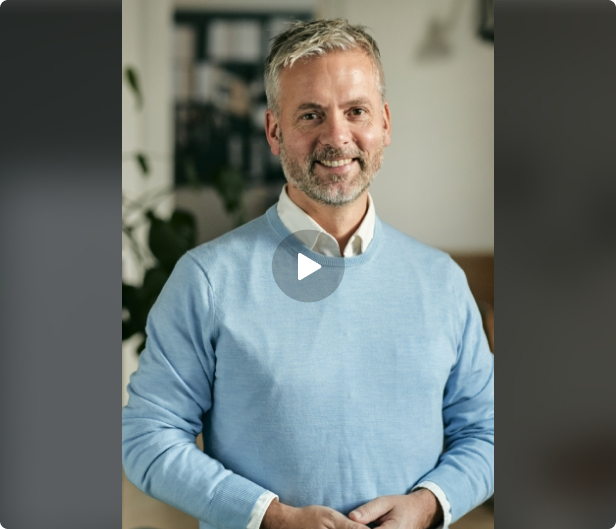
In this short video, I explain how one person can work on a relationship shaped by autism, even when the partner does not come.
You can also send me an email
Autism couples therapy alone Copenhagen is one-to-one work for someone whose relationship is shaped by autism, whether you are autistic or your partner is. Your partner does not attend. Sessions last an hour, in Danish or English, in person at my practice in central Copenhagen or online.
It is the individual side of autism couples therapy and part of neurodiverse couples therapy alone. If ADHD is part of it too, see AuDHD couples therapy alone.
You can request a free discovery call, book a session, review my client policy or contact me directly.
These sessions are for one person, coming alone, whose relationship is shaped by autism, their own or their partner’s.
Check these alternatives before booking.
You can also send me an email
The reviews shown here are shared by clients who have worked with me in therapy and chosen to reflect on their experience. They are collected via Google and displayed through an independent verification service, offering an open and transparent picture of how my work is experienced.
“In my clinical experience, autism often leaves two people feeling unseen by each other. Underneath, some are asking ‘Will you ever show me that I matter?’, and others ‘If I let you in, will it be too much for me?’. When you can hear your own question, and guess at your partner’s, the relationship becomes much easier to work with.”
Mark Colclough, MA, psychotherapist and EFT couples therapist
I am Mark Colclough, MA, a psychotherapist and EFT couples therapist specialising in expats and international couples. I work in English and Danish, from my practice in central Copenhagen and online.
Practising since 2004, I bring a bicultural perspective to work with individuals and couples across languages and cultural contexts. My work integrates depth-oriented psychotherapy with approaches such as integral psychotherapy, Gestalt therapy, Jungian psychoanalysis, and object relations theory. I also have specialist training in attachment theory, narcissism, and borderline personality disorder.
For support with life between cultures, explore expat psychotherapy or expat couples therapy. My practice is supported by ongoing training and supervision. To read more about my background, training, and approach, visit About me.

I regularly meet with experienced senior psychotherapists in Denmark and abroad to reflect on my work, challenge my thinking, and continue developing my skills. This ongoing process supports the quality of my individual and couples therapy, helping me offer thoughtful, ethical, and effective care.
My focus is simple: excellence, integrity, and impact.
If you want me to call you ASAP, or if you want to book me, use the buttons below.
You are welcome to get in touch. We can clarify what’s the right therapy for you.
You can also send me an email
Maja is autistic and works in a laboratory. Her boyfriend, Nikolaj, wants to talk through every disagreement at once, late in the evening. Maja shuts down, and he feels rejected. He thinks therapy would only be about her “issues”.
In our sessions, Maja learns to say early, in one sentence, that she needs time, and to suggest a time the next day to talk. She writes down what matters most to her before those talks. Nikolaj starts to trust that she will come back, and the late-night arguments become rare.
I have presented this clinical example as a compound of 22 years of clinical practice.
Understanding one side of a misunderstanding clearly is often enough to change the next one.
If your partner will not come to couples therapy, it can feel as if your hands are tied. They are not.
In one-to-one sessions, we look at what happens between you and what you can do differently.
Some partners refuse therapy outright; others say it is not the right time.
Starting alone is a common and useful first step.
If you are autistic, you may have spent years hearing that you are too blunt, too quiet or too rigid.
Here your way of thinking is treated as valid, and we look at what would make the relationship easier for you.
If your partner is autistic, you may feel lonely, confused or starved of the closeness you hoped for.
We look at what may be going on for them, and how to look after yourself too.
For some people, especially autistic people, a three-way conversation is tiring and hard to follow.
One-to-one sessions are calmer and easier to process.
A recent diagnosis, or the first suspicion of autism, can change how you see years of your relationship.
We give that new understanding time and space.
You may be weighing whether the relationship can work for you in the long run.
We look at that question carefully and without pressure.
If this sounds like you, a short written message is a good way to start.
You can also send me an email
Your journey is unique, and you do not have to walk it alone.
Fill out your contact information and I will call as soon as possible.
Support when you need it most.
Your message is treated confidentially and used only to respond to your enquiry. It is not sold or used for advertising. Please avoid including detailed or highly sensitive clinical information in this form. Information about processing, service providers and retention is available in the privacy policy.
Clear understanding first. Then small, concrete steps.
We look at communication, sensory needs and closeness between you, and at the steps that are in your hands.
We take one recent misunderstanding and go through it slowly: what was said, what each of you probably heard and what happened next.
Yes. We find clear, concrete words for needs such as quiet time, notice before changes or more affection.
Yes. A flat tone or a long silence may mean overload, not anger. A sigh may mean tiredness, not criticism. We practise reading those signals better.
Yes. We plan recovery time and sensory limits so you can rest without your partner feeling shut out.
Yes. We write down what you want to say, practise it and plan what to do if the conversation goes off course.
Often there are fewer painful misunderstandings, you feel less blamed or less alone, and your partner begins to respond differently.
You can also send me an email
Your partner does not have to agree. You only need to want to understand.
In the first hour, I ask how you communicate best, what is happening in the relationship and what you would like to change. If another kind of help would suit you better, I will tell you.
It follows a clear structure that I explain at the start. You describe your relationship and a recent hard moment, and leave with one thing to notice.
I keep light low and the pace steady, explain the plan in advance and allow writing instead of talking. You are welcome to send notes before a session.
Yes, if you both want that. Some people later move on to joint autism couples therapy sessions.
Often weekly or fortnightly at first, then less often. We agree a steady rhythm.
A bundle fixes a number of hours in advance and costs 10 per cent less. Many autistic clients like the predictability. See the cards lower down.
You understand the misunderstandings better, you feel steadier at home and the arguments are shorter. Then we review together.

Related services side by side.
| Option | Choose it when | Pace |
|---|---|---|
| Autism couples therapy alone (this page) | You come alone; autism is central. | 1 hour, weekly or fortnightly |
| Autism couples therapy | Your partner comes too. | 2 hours, every two to three weeks |
| AuDHD couples therapy alone | ADHD is part of it too. | 1-hour individual sessions |
| Neurodiverse couples therapy alone | A mixed or unclear picture. | 1-hour individual sessions |
One-to-one sessions about a relationship shaped by autism, yours or your partner’s. Sessions are in Danish or English in central Copenhagen.
Often, yes. When you understand the pattern and respond differently, your partner has to adjust too.
Yes. Many autistic people come to understand their own needs, find words for them and feel less at fault.
Yes. Many partners of autistic people come to understand what is going on and find ways to feel closer and less alone.
No. Self-identification or a suspicion is fine. What matters is how differences show up between you.
Then AuDHD couples therapy alone covers both autism and ADHD.
No. I do not contact your partner, and confidentiality follows my client policy.
It varies. Every few sessions we check together whether the work is still useful.
An hour costs 1,550 DKK and is VAT exempt. Every price is on my prices page, and bundles are 10 per cent cheaper. Online sessions cost the same and last just as long.
Email me, use the booking calendar or ask for a free 30-minute call.
You can also send me an email
My mission is to help individuals, couples and families rediscover connection, communicate with understanding, and build a stronger, more loving relationship that can thrive through any challenge.
My vision is to create a world where every person in my therapy room feels supported, connected, and empowered to grow, and to step one step closer to your Self.

Join the newsletter and receive five practical tips for nurturing healthy relationships – with yourself and the people around you.
No spam. Just mindful insights.
I have designed this website to offer you a private, ad-free experience. Your personal data is never used, sold or shared with third parties. A few cookies are necessary for the site to work. If you say yes to helping me, I would also like to use one or two that show how the site is used, so I can improve its flow and content for you. It is completely pseudonymous, which means it does not identify you by name.
Please fill out this information and I’ll contact you soon. I use your details to reply to your enquiry, talk through practicalities and, if you wish, book a session. Please do not write sensitive information in the message field.
Clicking the button adds your email address to my mailing list. Please read the Privacy Policy for more information.
P.S. I’ll call you in a bit!
