
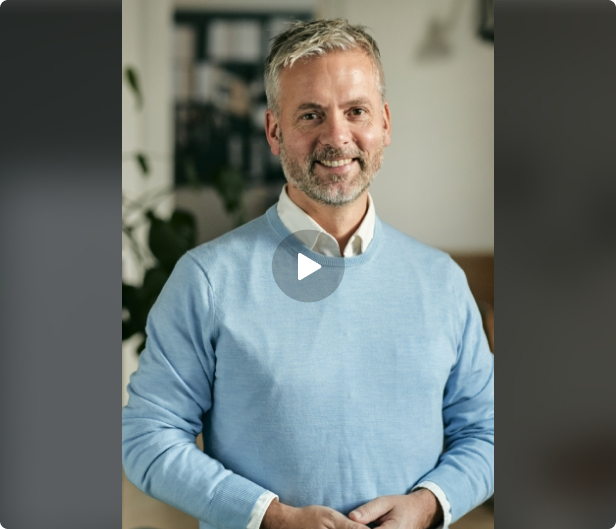
This short video shows how one partner, working alone, can change a relationship where two minds work differently.
You can also send me an email
Neurodiverse couples therapy alone Copenhagen is one-to-one work for a person whose relationship is shaped by autism, ADHD, AuDHD or a similar profile, in either partner. Your partner does not take part. Each session is one hour, in English or Danish, in person in my rooms in central Copenhagen or online.
It is the individual side of neurodiverse couples therapy. There are also pages for ADHD couples therapy alone, autism couples therapy alone and AuDHD couples therapy alone.
You can request a free discovery call, book a session, review my client policy or contact me directly.
This service suits one person, coming alone, whose relationship is shaped by autism, ADHD, AuDHD or a similar profile in either partner.
If one of these describes you better, the linked page is probably a closer match.
You can also send me an email
The reviews shown here are shared by clients who have worked with me in therapy and chosen to reflect on their experience. They are collected via Google and displayed through an independent verification service, offering an open and transparent picture of how my work is experienced.
“When someone comes to me alone, I keep seeing how much one person can shift in a neurodiverse relationship. Underneath, some are asking ‘Will you ever meet me halfway?’, and others ‘If I show you how hard this is for me, will you still respect me?’. Once you can hear those questions in yourself, and guess at them in your partner, the arguments start to lose their grip.”
Mark Colclough, MA, psychotherapist and EFT couples therapist
I am Mark Colclough, MA, a psychotherapist and EFT couples therapist specialising in expats and international couples. I work in English and Danish, from my practice in central Copenhagen and online.
Practising since 2004, I bring a bicultural perspective to work with individuals and couples across languages and cultural contexts. My work integrates depth-oriented psychotherapy with approaches such as integral psychotherapy, Gestalt therapy, Jungian psychoanalysis, and object relations theory. I also have specialist training in attachment theory, narcissism, and borderline personality disorder.
For support with life between cultures, explore expat psychotherapy or expat couples therapy. My practice is supported by ongoing training and supervision. To read more about my background, training, and approach, visit About me.

I regularly meet with experienced senior psychotherapists in Denmark and abroad to reflect on my work, challenge my thinking, and continue developing my skills. This ongoing process supports the quality of my individual and couples therapy, helping me offer thoughtful, ethical, and effective care.
My focus is simple: excellence, integrity, and impact.
If you want me to call you ASAP, or if you want to book me, use the buttons below.
You are welcome to get in touch. We can clarify what’s the right therapy for you.
You can also send me an email
Jakob is autistic and works as an accountant. His wife, Pernille, wants to talk about feelings every evening, and he freezes. She calls him cold; he feels he can never get it right. Pernille has refused couples therapy twice, saying Jakob is the one who needs help.
In our sessions, Jakob learns that his freezing is overload, not indifference, and finds a way to say so: ‘I want to talk, but I need twenty minutes first.’ He also starts asking Pernille one question about her day each evening. After a few weeks, she notices the change and asks whether she can come along.
I have presented this clinical example as a compound of 22 years of clinical practice.
A relationship is a loop between two people. When one of you steps differently, the whole loop shifts.
Perhaps your partner has refused couples therapy, or you sense that a joint session would only turn into another argument.
Working alone, you can still understand the loop you are caught in and change your part of it.
A partner who says no to therapy is common, and it does not mean nothing can be done.
We start with you, and sometimes the door to joint work opens later.
If you are autistic or have ADHD, you may feel that every conflict ends with you being the one who must change.
Here we look at your needs as real, not as a list of faults.
If it is your partner whose mind works differently, you may feel lonely, confused or worn down by explaining.
We look at what may be happening for them and what you need for yourself.
For some people, a room with a partner and a therapist is simply too intense at the moment.
One-to-one sessions are calmer and easier to process.
Some people want to understand their own reactions and history before tackling the relationship together.
That can be a strong starting point.
You may be weighing whether the relationship can work for you in the long run.
We give that question time, without pushing you either way.
If you see yourself here, send me an email or book a first hour.
You can also send me an email
Your journey is unique, and you do not have to walk it alone.
Fill out your contact information and I will call as soon as possible.
Support when you need it most.
Your message is treated confidentially and used only to respond to your enquiry. It is not sold or used for advertising. Please avoid including detailed or highly sensitive clinical information in this form. Information about processing, service providers and retention is available in the privacy policy.
Your side of the loop first. Then small changes you can start at home.
We look at how your mind and your partner’s meet, where the clashes happen and which steps are yours to take.
Together we take one recent clash and slow it right down: what you noticed, what you felt, what you did next. That is where the loop becomes visible.
Yes. We look for short, concrete ways of asking for quiet, routine, contact or help, so your partner hears a request instead of a complaint.
Yes. A shutdown, a sharp tone or a long silence may mean overload rather than rejection. Knowing that changes how you respond.
Yes. We look at rest, sensory limits and practical load, so you can recover without your partner feeling abandoned.
Yes. We practise pausing early, saying you will come back to it, and then really coming back.
Often the arguments get shorter, you feel less blamed or less alone, and your partner starts to respond differently too.
You can also send me an email
Your partner does not need to agree. Curiosity about the relationship is enough.
In the first hour, I ask how you think and communicate best, what is happening at home and what you hope for. If another kind of help would fit better, I say so.
It is calm and unhurried. You describe your relationship and a typical hard moment, and you leave with one or two things to notice before we meet again.
Yes. Lower light, a different chair, more pauses, writing instead of talking or notes sent beforehand are all welcome.
Yes, if you both want it. Some people later move on to joint neurodiverse couples therapy sessions.
Often weekly or fortnightly at first, then less often. We agree the rhythm together.
Individual work usually takes several weeks, so a bundle lowers the hourly price and fixes a plan. See the bundle cards further down.
You understand your own reactions better, misread your partner less and home feels calmer. At that point we review the plan.

Not sure which page fits? Compare the closest services.
| Option | Choose it when | Pace |
|---|---|---|
| Neurodiverse couples therapy alone (this page) | You come alone; any neurodivergent profile. | 1 hour, weekly or fortnightly |
| Neurodiverse couples therapy | Your partner comes too. | 2 hours, every second or third week |
| ADHD couples therapy alone | ADHD is the main theme. | 1-hour individual sessions |
| Autism couples therapy alone | Autism is the main theme. | 1-hour individual sessions |
One-to-one sessions about a relationship shaped by autism, ADHD, AuDHD or something similar. I offer them in English or Danish in central Copenhagen.
Often, yes. When one person changes how they respond, the other usually has to adjust too.
Yes. Many neurodivergent people come to understand their needs, find words for them and stop feeling like the problem.
Yes. Many partners come to understand what is going on, protect their own wellbeing and respond with less frustration.
No. A diagnosis is not needed. What matters is that different ways of processing affect your relationship.
Yes. If one profile is central, see ADHD couples therapy alone, autism couples therapy alone or AuDHD couples therapy alone.
No. I do not contact your partner. Confidentiality follows my client policy.
It varies a lot. We check together, every few sessions, whether the work is still useful.
A 1-hour session costs 1,550 DKK and is VAT exempt. The prices page lists everything, and bundles take 10 per cent off. Online sessions cost the same and last just as long.
Use the online calendar, or start with a free 30-minute call. An email is fine too.
You can also send me an email
My mission is to help individuals, couples and families rediscover connection, communicate with understanding, and build a stronger, more loving relationship that can thrive through any challenge.
My vision is to create a world where every person in my therapy room feels supported, connected, and empowered to grow, and to step one step closer to your Self.

Join the newsletter and receive five practical tips for nurturing healthy relationships – with yourself and the people around you.
No spam. Just mindful insights.
I have designed this website to offer you a private, ad-free experience. Your personal data is never used, sold or shared with third parties. A few cookies are necessary for the site to work. If you say yes to helping me, I would also like to use one or two that show how the site is used, so I can improve its flow and content for you. It is completely pseudonymous, which means it does not identify you by name.
Please fill out this information and I’ll contact you soon. I use your details to reply to your enquiry, talk through practicalities and, if you wish, book a session. Please do not write sensitive information in the message field.
Clicking the button adds your email address to my mailing list. Please read the Privacy Policy for more information.
P.S. I’ll call you in a bit!
